


2027 Retirement Plan Contribution Limits Announced
Why saving enough for retirement matters
Saving enough each year is the most important step toward being retirement ready. The next step is investing consistently for your life stage and other goals.
Not everyone needs to save up to the IRS maximum. Some people do, and some should save even more outside their retirement plan to reach their goals.

2027 Contribution limits
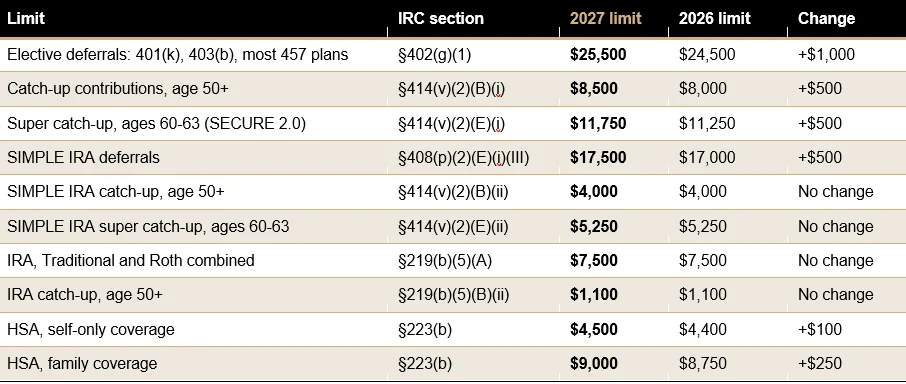
Retirement account limits can rise each year, giving you a chance to save more. The IRS just announced the 2027 retirement plan limits. HSA limits are set separately and are also included below.
Don’t wait to be signed up: start saving now

The hardest part of saving is getting started. In 2025, 90% of workers under 25 who were automatically enrolled were saving in their plan, but only 24% of those who had to sign up on their own had done it.*
Don’t wait for someone else to sign you up. Log in to your plan account and check that you’re contributing. If you aren’t, enroll today, even at a small percentage. Starting early in your career gives your savings the most time to grow.
Age 50 or older? Use catch-up contributions to save even more
Once you turn 50, the IRS lets you save beyond the standard limits. These extra amounts, called catch-up contributions, are available to anyone who turns 50 or older at any point in 2027. They sit on top of the regular $25,500 limit for 401(k), 403(b) and governmental 457 plans and the $7,500 IRA limit, and they’re one of the simplest ways to boost your retirement savings in the years before you retire.
Two things to check with your plan: whether it offers the higher catch-up for ages 60 to 63, and how the new Roth catch-up rule applies to you. If your wages from your employer last year were above the IRS threshold, your catch-up contributions generally must be made as Roth, or after-tax, contributions.
Put your savings on autopilot
Many plans offer an automatic increase feature, either by default or as an option. It raises your savings rate a little each year, typically by 1% to 2%, without you having to remember to make the change. If your plan offers it as an option, it’s worth turning on: when the feature was optional in 2025, only 25% of employees chose to use it.*
If you can’t make a big jump in savings now, small automatic increases can still have a big impact over time. If the feature isn’t isn’t active on your account, contact your retirement plan provider’s customer service team to ask how to turn it on.
Save at a level that fits your goals
Deciding how much to save is easier with clear goals for retirement and for other needs, like a home down payment or emergency savings. If your goals aren’t clear yet, these rules of thumb are a good start:
- Always capture your full employer match. A match is free money, and you can’t get it back once the year passes. Some plans require you to contribute every pay period to receive the full match, so a large one-time contribution may not qualify.
- Stretch now, adjust later. Save as much as you can today, then adjust up or down as your goals become clearer. Most pre-retirees wish they had saved more, sooner.
- Save at least 10% of your income. However,that may not be enough if you started late, plan to retire early, expect to live longer than average or have high spending goals in retirement.
- Use the 50/30/20 budget. Spend about 50% on needs and 30% on wants, and save 20%. Within that 20%, put 10% to 15% toward retirement and the rest toward goals like a down payment, emergency savings or a 529 college savings account.
The risk of delaying
Waiting to save means missing years of compound growth. Starting later requires much larger contributions to reach the same goal, or working longer and spending less in retirement.

SOURCES
* Vanguard, How America Saves 2026 (25th edition), 2025 plan-year data: participants increasing their savings rate (p. 6), use of automatic increases (p. 29), participation by plan design and age (p. 35), catch-up contributions (p. 42)
IRS news release IR-2026-136 (Notice 2026-66): 2027 contribution limits
IRS news release IR-2025-111 (Notice 2025-67): 2026 contribution limits
The information provided herein is for informative and educational purposes only. The use of hyperlinks to third party websites is not an endorsement of the third party. Third party content has not been independently verified. To understand how this content may apply to you, please contact a financial advisor.